
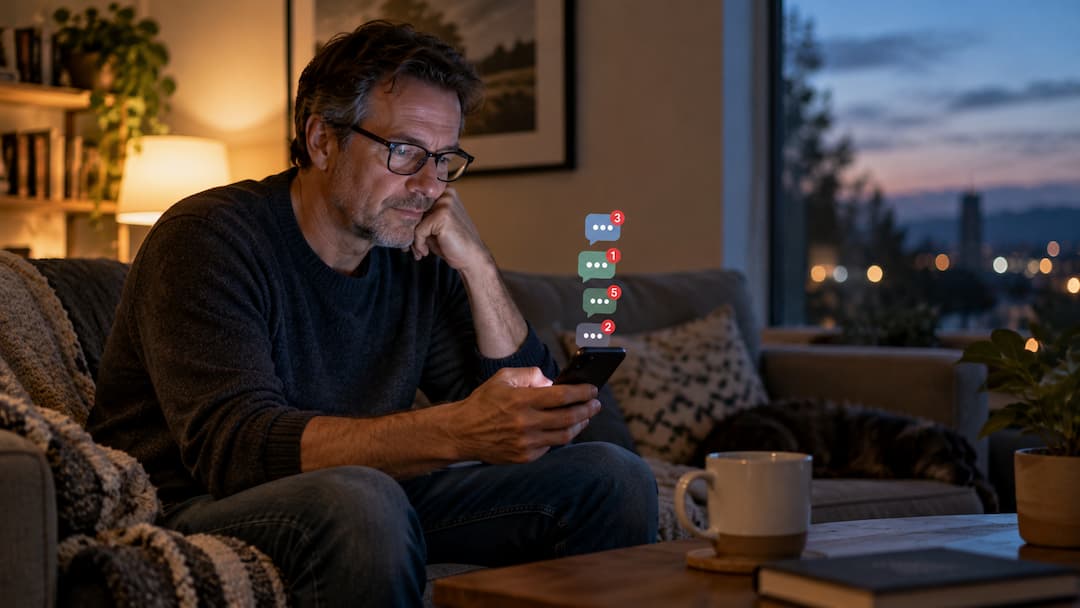
There was a time when getting in touch with someone required some effort. You called and hoped they were home. You left a message on an answering machine. You wrote a letter and waited days or weeks for a reply. If you made plans to meet someone, you generally decided where and when beforehand because you couldn’t simply text them from the parking lot.
Today, almost everyone we know is potentially seconds away. We text, use Messenger, send photos and memes, and carry conversations from our computers to our phones and back again. We can often see when a message was delivered and sometimes exactly when it was read.
Yet for all this access to one another, many of us still feel lonely or disconnected.
Technology has made reaching people almost frictionless. It hasn’t made intimacy frictionless.
I’ve written before about coping with loneliness and mental health and about why human connection matters so much. This time, though, I’m interested in something a little more specific. What happens when we are technically in touch with people, sometimes regularly, but the communication itself doesn’t always leave us feeling connected?
When Is a Text a Message, and When Is It a Conversation?
I grew up long before text messaging existed, but I’ve adapted to it pretty well. In fact, these days I generally prefer receiving a text over getting a phone call.
What I haven’t completely adapted to is the strange uncertainty surrounding what texting actually is.
Sometimes it is clearly asynchronous. I send you something this morning. You’re busy. You answer this afternoon. That’s perfectly normal, and one of the advantages of texting is that neither of us has to be available at exactly the same moment.
Other times, texting starts behaving much more like a live conversation. Someone messages me, I answer 30 seconds later, and then seven minutes pass before the next response. I answer again. Another nine minutes pass. A conversation containing perhaps five minutes of actual interaction stretches across half an hour or more.
Nobody has necessarily done anything wrong. The other person may be cooking dinner, watching television, working, talking to somebody else or doing any number of things while they’re texting. Still, it creates an odd kind of half-attention. I find myself wondering whether we’re actually having a conversation or simply exchanging messages whenever the other person happens to look at their phone.
It gets stranger when an exchange has been moving rapidly for ten or fifteen minutes. Messages are going back and forth almost as quickly as they would in a spoken conversation. The other person asks a question. I answer it, expecting the conversation to continue, and then they disappear.
Hours pass. Sometimes days.
There may be a perfectly reasonable explanation, but I’m left without knowing what happened. A face-to-face conversation has social cues that tell us when an interaction is ending. A phone call usually ends with some version of goodbye. Texting allows us to move from active conversation to complete absence without any acknowledgement that the interaction has changed.
Maybe that’s one of texting’s greatest conveniences. It is also one of the reasons it can be so ambiguous.
Not Every Message Is Just Information
I’ve realized that part of my frustration comes from the fact that we often talk about text messages as though they’re all doing the same job.
They aren’t.
If I text someone to let them know road construction starts tomorrow, I may not need a response at all. If I ask what time we’re meeting for breakfast, I’m looking for information. If I tell a friend that something frightening has happened to someone I love, I’m probably looking for something more than information.
Then there are the seemingly unimportant messages. I send someone something funny because I think they’ll laugh. I send a photograph because I know they’ll appreciate it. I mention some ridiculous thing that happened during my day.
On the surface, none of that is important.
But if I send a friend something funny, the point isn’t simply to transfer a joke from my phone to theirs. I’m imagining their reaction. Maybe they’ll laugh. Maybe they’ll send an emoji. Maybe they’ll come back with something even funnier.
What I’m really saying is, share this little moment with me.

Relationship researchers sometimes describe these small attempts to engage another person as bids for connection. They don’t have to be serious or profound. A joke, a question, a photograph or a comment about something we both know can all be small ways of reaching toward another person.
When one of those messages sits untouched for several days and is never acknowledged, the joke itself may no longer matter. The moment I was trying to share has already passed.
That doesn’t mean every message deserves an immediate response. It means that communication isn’t always about transferring information. Sometimes we’re asking another person to briefly join us in an experience.
Responsiveness Is More Than Replying Quickly
There is an important distinction here between response time and responsiveness.
Psychologists use the term perceived responsiveness to describe the feeling that another person understands us, validates what we’re saying and responds with care. Someone can answer a message within seconds and still leave us feeling unheard. Another person may take several hours to answer but respond in a way that makes it obvious they actually paid attention.
A 2025 study of text-based conversations involving 260 participants looked at perceived responsiveness in digital communication. The researchers found that messages people experienced as more responsive were also associated with greater feelings of closeness and relationship satisfaction. The study specifically examined emojis as one way text can carry some of the nonverbal information we normally receive face to face.
That doesn’t mean adding a smiley face will save a struggling friendship. What interests me is the larger point: how a response makes us feel can matter at least as much as how quickly it arrives.
Research on long-distance romantic relationships points in a similar direction. In a study of 647 young adults, more frequent and responsive texting was associated with greater relationship satisfaction among people in long-distance relationships, where digital communication naturally carries more of the burden of maintaining connection. The researchers did not claim that more texting automatically creates better relationships, and that distinction matters. The study is available through PubMed.
More communication isn’t necessarily better communication.
Being in Contact Isn’t the Same as Feeling Connected
The U.S. Surgeon General’s advisory on social connection makes a distinction that I think is useful here. Social connection involves more than how many people we know or how frequently we interact with them. It also includes what our relationships provide and, importantly, the quality of those relationships and interactions.
That makes intuitive sense to me.
You could exchange dozens of messages with someone and come away feeling strangely empty. Another person might send two sentences asking how you’re doing and remembering something important that’s happening in your life, and somehow those two sentences mean more.
Why?
I think part of it is that they provide evidence of something many of us quietly need from relationships: I existed in this person’s mind even when I wasn’t standing in front of them.
They remembered.
They didn’t need anything.
I didn’t have to remind them what was happening before they asked.
That kind of moment can mean a great deal, particularly if you’ve been feeling lonely or disconnected. Loneliness itself isn’t simply a matter of being physically alone. As I’ve explored elsewhere, we can feel lonely even while surrounded by people if we don’t feel seen, understood or meaningfully connected.
Sometimes We Don’t Need More Contact. We Need to Feel Known.
Think about the people with whom you feel safest.
Chances are, you aren’t constantly calculating how long they took to answer the last message. You probably aren’t counting who initiated the last three conversations or staring at a read receipt trying to decide what it means.
Often, that’s because the rest of the relationship has already given you enough information.
They remember things you’ve told them. They ask how something turned out. They listen when you have something to say. They make time occasionally. They share things from their lives and leave room for yours. If some time passes, eventually somebody comes back and picks up the thread again.
When that foundation is there, an unanswered message doesn’t necessarily carry very much weight.
It’s often when the foundation starts feeling uncertain that we begin counting.
I explored something similar in What Nobody Taught Us About Relationships, where I wrote about how easy it can be to become so focused on accommodating another person that we lose sight of our own needs. Digital communication creates another place where that can happen. We can spend a lot of time trying to interpret someone else’s silence without stopping to ask what kind of communication actually works for us.
Silence Gives Our Minds a Lot to Work With
One of the strangest things about digital communication is that it can give us information about the message without giving us much information about the person.
The message was delivered.
Maybe it was read.
Then nothing happens.
That empty space can be surprisingly difficult to interpret, and our minds are very good at filling it.

Did I say something wrong? Are they annoyed with me? Am I bothering them? Why did they ask the question if they didn’t want the answer? Maybe I’m not as important to them as I thought.
For someone already dealing with loneliness, anxiety, depression, rejection or uncertainty about a relationship, those thoughts can gather momentum pretty quickly.
There is an important distinction I keep coming back to, though.
Feeling unimportant is an emotional experience. Deciding that someone else considers us unimportant is a conclusion.
Those two things are not necessarily the same.
When I don’t answer someone, I know what’s happening on my side. Maybe I’m working. Maybe I’m tired. Maybe something came up. Maybe I saw the message at a bad moment and fully intended to return to it later. Maybe I don’t know how to answer yet.
When somebody else doesn’t answer me, I don’t have access to any of that context.
I just have the silence.
That doesn’t mean we should ignore patterns. Sometimes reduced communication really does reflect reduced interest or investment in a relationship. People grow apart. Priorities change. Some relationships become less important than they once were.
The trouble is that response time alone usually can’t tell us which explanation is true.
Texting Is Useful, but It Doesn’t Give Us Everything
I don’t want this to become an argument against texting because I use it constantly and generally prefer it.
Texting lets us maintain relationships across enormous distances. It allows us to reach out without demanding that somebody immediately stop what they’re doing. For people who find phone calls difficult or draining, it can make communication easier. It can also provide connection on days when we don’t have the energy for much else.
Still, text removes many of the things human beings normally rely on to understand one another. There is no tone of voice unless we somehow create one through words. There is no facial expression, spontaneous laughter, pause, touch or comfortable silence across a table.
A recent experiment involving 348 young women compared support from a close friend delivered in person, by video, by voice and through text messaging. In-person, video and voice support produced fairly similar perceptions of support, while text-based support was associated with less positive emotion and was perceived as less empathetic than in-person support. The research is available through PubMed.
Another real-world study following people’s daily interactions found that less lifelike forms of communication were associated with people reporting feeling lonelier, sadder, less affectionate and less supported afterward. Again, that doesn’t prove texting makes us lonely. It does suggest that different forms of communication may not be emotionally interchangeable. That study can also be found through PubMed.
Convenience and emotional richness aren’t always the same thing.
We Don’t All Use Messaging the Same Way
There is another side to this that matters just as much.
For some people, messaging itself can feel like a burden.
A notification doesn’t feel like a friendly invitation. It feels like another demand waiting to be dealt with. Someone living with depression, anxiety, chronic illness, exhaustion, caregiving responsibilities, work stress or simple information overload may genuinely need to disengage from conversations for hours or days.
Other people simply don’t view texting as a live medium. To them, every message means, I’ll answer when I get around to it.
That isn’t inherently disrespectful.
I don’t believe the answer is to demand that everyone we care about remain continuously available. We all need control over our time and attention. The Surgeon General’s recommendations around social connection talk about investing in relationships through consistent, frequent and high-quality engagement, but that still doesn’t mean permanent accessibility.
We are allowed to put the phone down.
We are allowed to be unavailable.
We are allowed to take care of ourselves.
At the same time, protecting our own attention doesn’t require us to forget there’s another human being on the other side of a conversation.
If I’ve been actively texting someone for fifteen minutes and suddenly need to do something else, it takes only a few seconds to say, Something came up. I’ll get back to this later.
Or, I’m multitasking, so my replies might be slow.
Or, I don’t have the headspace to answer this properly right now, but I’ll come back to it.
I don’t think every casual message requires an announcement that we’re going offline. That would make texting unbearable. But once an exchange has clearly become an active conversation, a small amount of communication can remove a surprising amount of ambiguity.
It doesn’t promise constant availability.
It simply communicates that availability has changed.
Sometimes the Message That Matters Most Is the One You Didn’t Ask For
One of the smallest forms of connection may also be one of the most powerful.
An unsolicited message.
Thinking about you.
How did your appointment go?
How’s your mom?
Happy birthday.
I saw this and immediately thought of you.
These messages matter in a slightly different way because we didn’t create the interaction ourselves. We didn’t check on the other person first. We didn’t ask for attention. We didn’t remind them of what was happening.

For a moment, we simply existed in someone else’s thoughts, and they decided to tell us.
That doesn’t require a two-hour conversation afterward. Sometimes the message itself is enough.
I’ve become increasingly convinced that a lot of meaningful connection is built this way. Not necessarily through dramatic declarations of friendship, but through repeated little pieces of evidence that we are still present in one another’s lives.

Connection Requires More Than Access
I don’t think we need a new set of rules telling people how quickly they’re supposed to answer messages.
Reply within twenty minutes.
Never leave somebody on read.
Always announce when you’re leaving a conversation.
Rules like that would turn one of the most flexible forms of communication we’ve ever had into another source of stress.
Perhaps what we need instead is more awareness of what we’re doing when we communicate.
Sometimes we’re exchanging information. Sometimes we’re passing time. Sometimes we’re asking for help or offering it. Sometimes we’re sharing something completely insignificant.
And sometimes, beneath a joke, a photograph, a question or an ordinary little story about our day, what we’re really saying is:
Connect with me for a moment.
We won’t always recognize those invitations. We certainly won’t always have the capacity to accept them. Sometimes we’ll answer late. Sometimes we’ll forget. Sometimes life will pull us away halfway through a conversation.
That’s part of being human.
Maybe closeness doesn’t require perfect responsiveness. Maybe it requires enough moments of attention, curiosity, remembering and returning that neither person is left continually wondering whether the relationship exists mostly in their own mind.
Because being reachable isn’t the same thing as being present.
And being in contact isn’t always the same thing as being connected.